The Growing Strain on the Power Grid
The global power grid is facing unprecedented challenges as electricity demand surges due to the proliferation of data centers, electric vehicles, and renewable energy sources. At the heart of this infrastructure lies the power transformer, a century-old technology that is now being pushed to its limits. One of the most critical issues is the risk of insulation breakdown, which remains the primary cause of transformer failures.
A team of researchers from multiple institutions has developed a groundbreaking solution using a wood-based material that could revolutionize how power transformers operate. This innovation addresses the limitations of traditional insulation methods and offers a sustainable alternative for modernizing the grid.
Why Current Insulation Methods Fail
Most large power transformers in the United States are over 25 years old, with an average lifespan of just 30 years. Their insulation systems typically use oil-impregnated Kraft paper (OIP), a material that dates back to the 1890s. This method relies on cellulose fibers soaked in insulation oil, forming a three-dimensional network of oil pockets.
However, OIP has several drawbacks. The oil has significantly lower dielectric strength than cellulose, allowing electrical breakdown to occur more easily through the interconnected oil regions. Additionally, OIP is not very durable under physical stress and does not conduct heat well, leading to increased temperatures and accelerated degradation of the material.
A New Approach: Oil-Impregnated Densified Wood
The research team, including experts from Yale University, the University of Maryland, the University of Texas at Austin, Brookhaven National Laboratory, the USDA Forest Products Laboratory, and Rensselaer Polytechnic Institute, took a different approach. Instead of using conventional pulp paper, they started with natural wood veneer, which has a unique anisotropic structure with aligned pores.
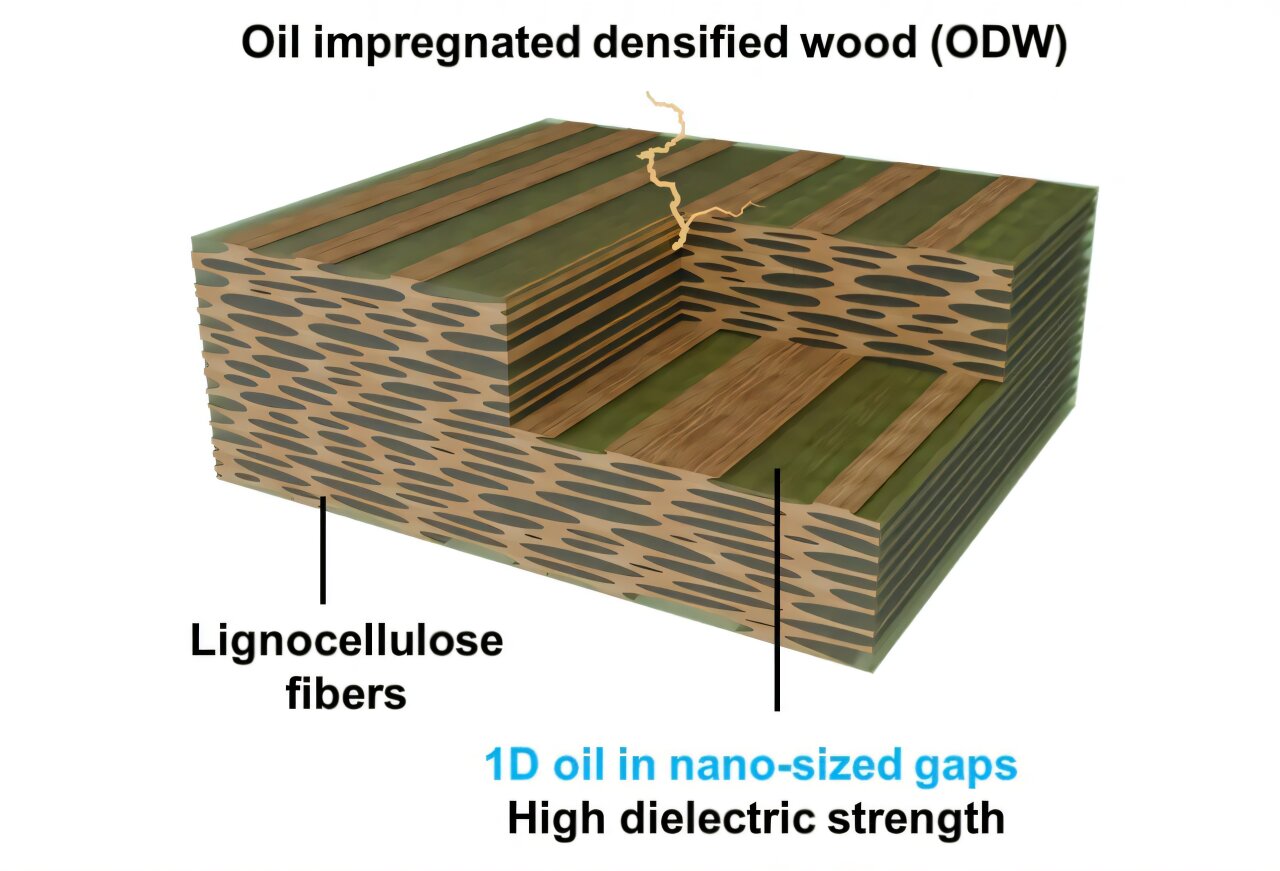
They treated the wood with a mild alkaline solution to remove some of its natural compounds, such as lignin and hemicellulose. Then, they soaked the wood in insulating oil and applied pressure to make it denser. The result is a new material called oil-impregnated densified wood (ODW).
During the densification process, the original micron-sized oil-filled channels shrink into isolated, one-dimensional nanosized channels. These nanometer-scale oil channels are separated by dense, highly aligned cellulose walls. Unlike conventional OIP, which has a continuous 3D oil network, ODW’s design prevents electrical breakdown from propagating through the material.
Performance Advantages and Broader Applications
ODW demonstrates exceptional mechanical and thermal properties. It has a tensile strength 3.5 times greater than high-density OIP and a through-plane thermal conductivity 1.6 times higher. These characteristics make it ideal for withstanding the stresses and heat generated inside transformers.
Accelerated thermal aging tests showed that ODW retains over 70% of its tensile strength after six weeks at 150°C, far outperforming conventional OIP. The improved thermal conductivity also helps reduce operating temperatures, slowing the chemical degradation of the material.
To validate the material’s performance, the team built a planar transformer using ODW as its insulation box. Under load, the ODW-insulated transformer ran 10°C cooler than one using conventional plastic insulation, thanks to its superior heat dissipation.
The production process is compatible with roll-to-roll manufacturing and can use various wood species, such as basswood or balsa, offering scalability and flexibility in material selection.
Beyond oil-impregnated paper, the concept of using anisotropic, densified wood to create aligned 1D nanochannels for a dielectric medium could be applied to epoxy-impregnated systems in dry-type transformers, motors, and printed circuit boards.
A Sustainable Future for Power Transformers
As electrification continues to place growing demands on grid infrastructure, innovations like ODW provide a practical, eco-friendly, and scalable solution for creating longer-lasting, more reliable power transformers. This breakthrough highlights the potential of combining natural materials with advanced engineering to meet the needs of the 21st-century energy landscape.