For 17 years, San Francisco’s data portal, SF Open Data, has provided access to public information through downloads or API calls. This platform has been a valuable resource for academics, businesses, policy analysts, and tech enthusiasts. However, the process of accessing this data typically required some level of coding knowledge, data expertise, or technological proficiency—until now.
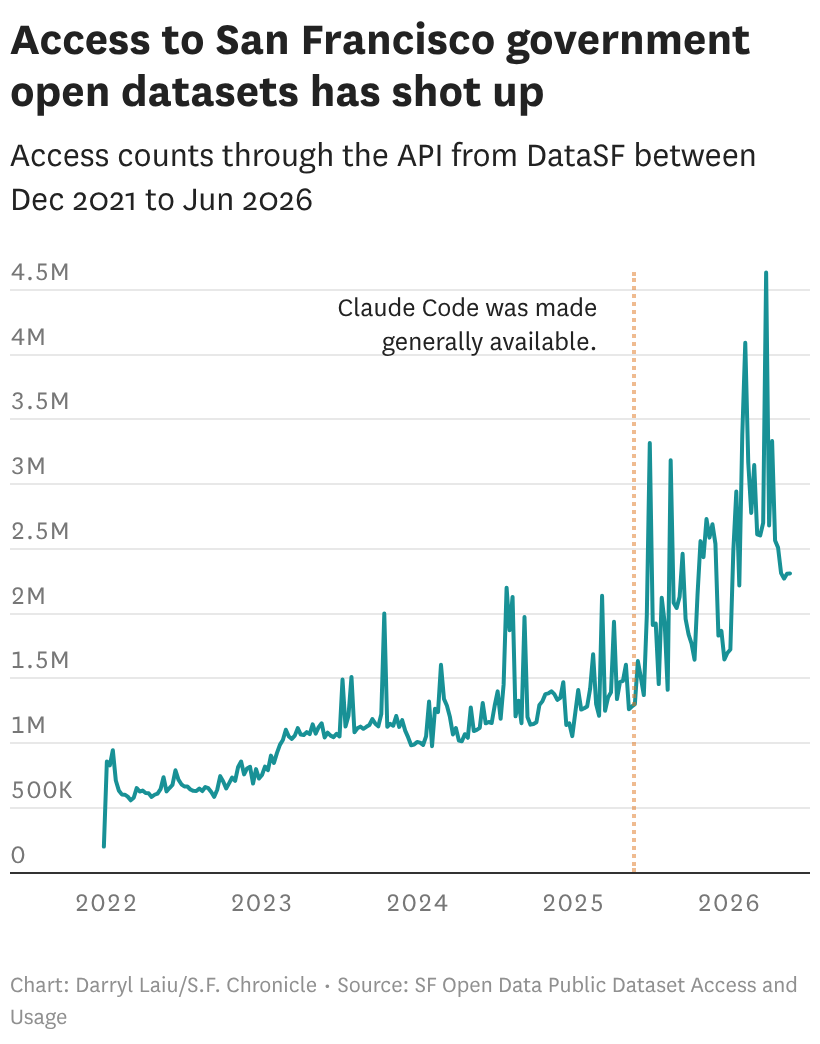
Average weekly requests to public datasets from SF Open Data have increased by about 120% since the introduction of Claude Code, the first widely available coding agent developed by a major frontier AI lab. This significant rise in usage is based on an analysis conducted by the Chronicle using DataSF’s Public Dataset Access and Usage data, which tracks how users interact with the open data portal.
SF Open Data was launched in 2009, but detailed records of dataset requests only date back to December 2021. The data also includes other forms of access, such as direct downloads. While downloads saw an even more substantial increase—2.6 times higher than before—API calls remain the most common method of accessing the datasets.
Before May 26, 2025, when Claude Code was released, the average weekly API calls stood at 1.1 million. After the release, this number doubled to 2.3 million per week. Public officials are excited about this development, seeing it as a positive shift in how people engage with data.
“I think this is kind of exciting, right?” said Soumya Kalra, the Chief Data Officer of San Francisco. She emphasized that coding agents like Claude Code have eliminated the need for technical skills, making data more accessible to everyone. “That barrier has come down with all of this,” Kalra added. “People can use AI to ask good civic questions and help them solve real problems.”
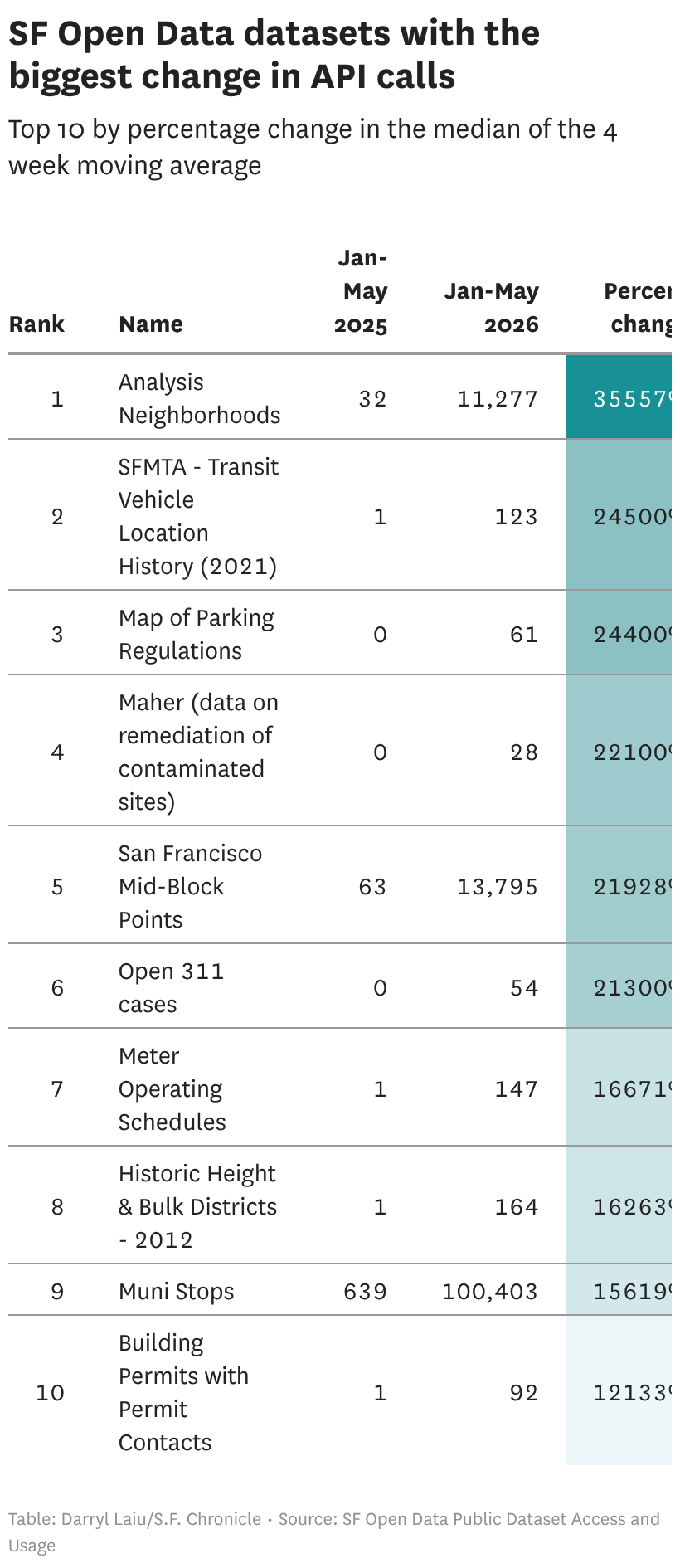
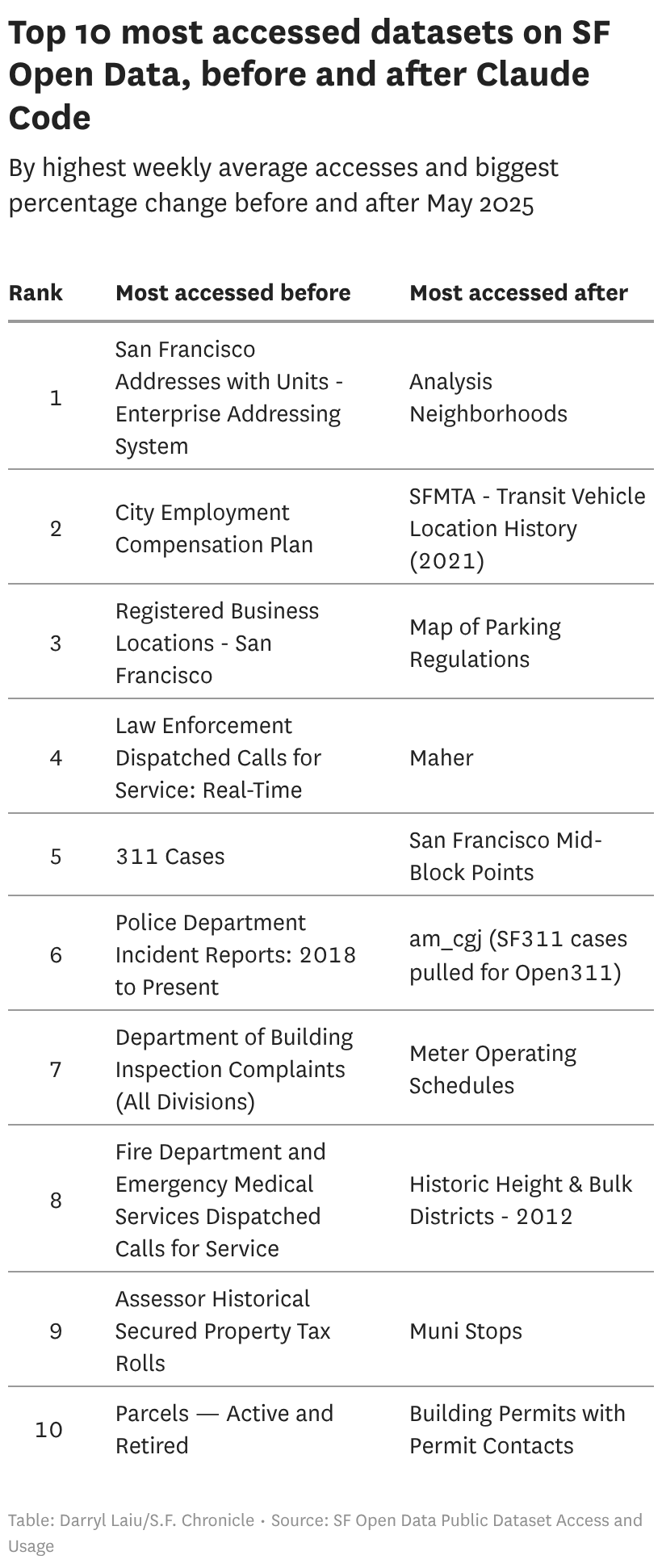
Interestingly, the use of Claude Code and similar tools hasn’t led to the same datasets being accessed as before. In fact, none of the top 10 most frequently accessed datasets prior to May 2025 experienced a significant increase in API calls. Instead, a new set of datasets has emerged as the most popular. There has been a notable surge in interest for data related to health inspections, building permits, and maps of different types of boundaries and incidents.
The biggest change was observed in a map that outlines the 41 neighborhoods in San Francisco. Before May 2025, the median number of requests for this dataset over a four-week period was around 32. By the same time in 2026, this number had skyrocketed to approximately 11,000 requests.
It’s not immediately clear why certain datasets have seen a sharp increase in usage while others have remained stable. However, it appears that some datasets have become more “spiky” in terms of demand. In many cases, API calls to a dataset spike for a day or two and then drop back down, possibly because a project has reached its conclusion.
Despite these fluctuations, the top datasets before and after the introduction of agentic tools still consist of a mix of business- and public safety-related information. Kalra believes that the rise in popularity of some datasets may be attributed to hackathons, which often generate disproportionate interest, especially in educational settings, for specific types of data.
Leela Solomon, founder of SafeHome and a board member of SF Civic Tech, agrees with this assessment. She notes that more people without traditional software development backgrounds are now engaging with civic tech projects. “During orientation, volunteers would spontaneously say that they have an idea, and that they are going to vibe code it,” she said.
Solomon also mentioned that while civic tech ideas are flourishing, turning them into impactful projects that gain widespread use is another challenge. “Not all of the projects will meet the bar, but that’s fine because you have to try many things for some of them to succeed,” she said. “Ultimately, I hope that (these technologies) open up the space democratically.”
Kalra believes that the most popular datasets help people answer specific questions that can improve their lives in San Francisco. “I think there’s a real opportunity for folks to leverage (these datasets) to answer questions that can help you live your life better in the city of San Francisco,” she said. “I mean, that is the whole point of having an open data program.”