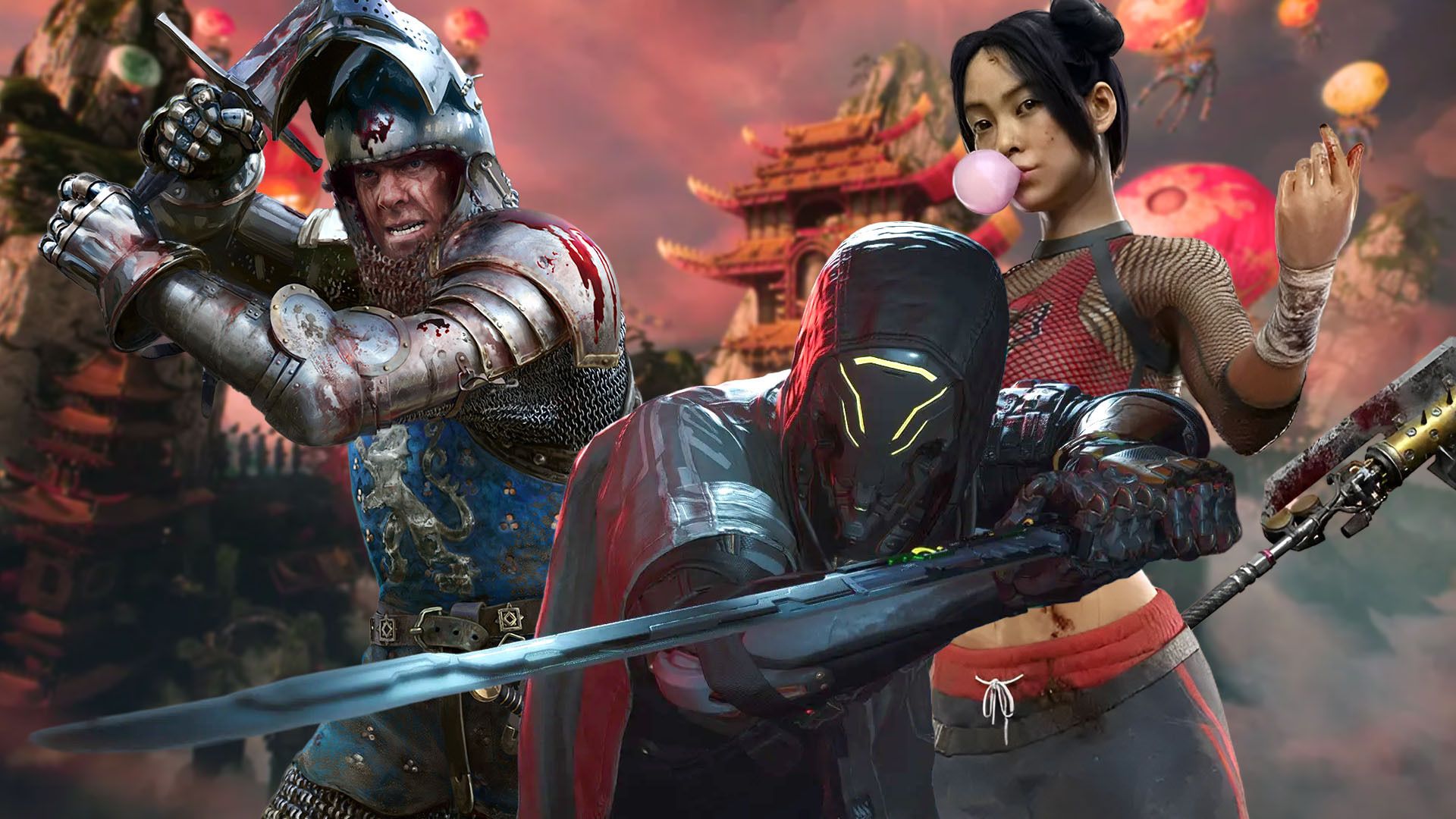
First-Person Combat: A Unique Challenge
First-person combat doesn’t always feel quite right. Controlling the camera and aiming a gun are easy enough to manage in tandem, but swap out that gun for a sword, and suddenly the momentum of a swing and the reliability of the targeting system can become finicky. That’s saying nothing of the sometimes nauseating feeling of spinning the camera one way while your sword swings the other.
There are a few games that absolutely nail first-person combat, though, and these next titles rank among the very best of them. Not only do they perfect the feel, weight, and accuracy of melee combat from a first-person perspective, but they manage to be pretty fantastic games in their own right as well.
What’s That Weapon?
Identify the silhouettes before time runs out.
Easy (7.5s) Medium (5.0s) Hard (2.5s) Permadeath (2.5s)
Start
5.0
s
0
/
10
Restart Back
Results
0
High Score: 0—
Play Again Back More Games
Ghostrunner 2: High-Speed Cyberninja Simulator
Very few games have made fast-paced first-person combat enjoyable (and not nauseating), but the Ghostrunner duology is a bright and shining exception. Not only is wall-running, grappling, dodging, and parrying bullets manageable (even all at once), but it feels fantastic and consistently satisfying to do so. These games perfectly capture the unrestrained speed and power you’d expect to feel when playing as a cyberninja.
Between the two, Ghostrunner 2 just barely edges out the first game as the better experience. Their gameplay is largely identical, but the sequel has a wider array of skills, deeper platforming, and a badass motorcycle that acts as your main transportation through a surprisingly freeform open-world level at the game’s midpoint. The story is an unexpected high point as well, providing some genuine surprises that only serve to elevate an already fantastic action game.
Dark Messiah Of Might And Magic: The Greatest Kick Mechanic In Gaming History
As far as classic first-person fantasy games go, they all live in the shadow of Skyrim, and few manage to carve out a niche of their own. Dark Messiah of Might and Magic is one of those few, largely because it places a stronger focus on action and physics-based combat than role-playing and build crafting. This is largely to its benefit, because while the story is mostly forgettable and alternate gameplay styles are ridiculously unbalanced, the action is first-class.
This is buoyed by one of the finest kick mechanics ever put into a video game. You can kick enemies off of cliffs, kick them into explosive barrels, kick them into spiked traps, or just kick them because they deserve it. Objects in the environment can be moved around to create chain reactions, and magic can be used to create hazards that slow enemies down (or kill them outright). As a sandbox, it’s still one of the best action games around. Just don’t go in expecting a deep RPG experience, and you’ll have a great time.
Kingdom Come: Deliverance 2: Stringent Dedication To Medieval Realism
If you want your action to come with a more grounded feel, Kingdom Come: Deliverance 2 is the only recommendation worth making. This medieval RPG is obsessively dedicated to presenting a genuine depiction of 15th-century Bohemia, warts and all. That means no magic, no elves, and no monsters… well, other than humans.
Instead, combat just means facing off against other trained soldiers, grappling with a combat system that requires a lot of patience and practice to nail down. The payoff, though, is astronomical, easily some of the most satisfying combat in the gaming medium. That’s to say nothing of KCD2’s layered RPG systems, making everything from exploration to side quests a factor in how NPCs perceive your version of Henry. It’s not a game for someone looking to jump in and kick ass, but if you’ve got the time to learn a bunch of layered systems and make them work for you, you’ll be thoroughly rewarded for the effort.
Chivalry 2: The Most Chaotic Multiplayer You’ll Ever Take Part In
On the surface, Chivalry 2 and Kingdom Come: Deliverance 2 look pretty similar. Even the screenshots included here could be almost interchangeable. However, once you get into the nitty-gritty, they couldn’t be more different. For one, Chivalry 2 is a multiplayer game. While it is primarily melee-combat focused (with some ranged options like crossbows), combat is less about finesse and mastery and more about getting down and dirty in the muck.
The game’s 64-player battles are chaotic, frantic, and at times, completely unfair. You can be on a great run only for someone to run up behind you and bash you to death with a lute. The game doesn’t care, and neither should you, because you’ll have the opportunity to return the favor at some point. With practice, that chaos eventually refines itself into a seeing-the-matrix moment where things slow down and your skill takes over, but the fun of Chivalry 2 is in the messy, hilarious, and thrilling experience of engaging in a massive medieval battle on a scale that few games can replicate.
Condemned: Criminal Origins: A Classic Horror-Thriller That’s Still One-Of-A-Kind
They don’t make ’em like Condemned: Criminal Origins anymore. While it starts a bit like a detective sim with some horror elements lurking in the fringes, eventually, you become trapped in the bowels of the game’s many abandoned structures, and that’s when it veers into true horror territory. Enemies in Condemned are smart, vicious, and most terrifying of all, completely human; they just have murder on the mind.
To combat these foes, you’ll be constantly picking up improvised weapons from the environment, each behaving differently depending on its size and durability. Sledgehammers and shovels are slower, but deal more damage and hold up longer than a crowbar or a lead pipe. As the enemies get weirder and the environments get darker, the tension ratchets up in tandem, and your only hope for survival is to master the melee combat system’s intricate balance, or pray that you find a gun around the next corner.
Dead Island 2: Just A Bloody Good Time
On the opposite end of the horror spectrum, Dead Island 2 and its expansive DLCs make up an open-world zombie game that offers the occasional scare, but is far more concerned with making sure that you have a good time bashing the undead into a red smear. Some zombies do pose a threat, like the hulking Crusher, but most of them are humanoids that are just begging for a wrench to the jaw.
Luckily, you’re just the person to provide said wrench. After choosing from a handful of Slayers to play as, which denote your particular skillset, you’re tossed into post-apocalyptic Los Angeles and effectively told to fend for yourself. That said, this is no survival game. Pick up whatever weapons you see lying around, start bashing, and watch as Dead Island 2’s impressive FLESH system procedurally busts up those zombies in truly bloody fashion, right down to the bones. This isn’t a game about posing a steep challenge to overcome; it’s about reveling in a power fantasy where the zombies are the ones being hunted for a change.
Shadow Warrior 3: Immature, Crass, And A Ton Of Fun
Shadow Warrior 3 takes a lot of cues from the modern DOOM remakes, but it sets itself apart in two ways: its campaign lasts for a fraction of the time, and where Doom Guy is a silent badass, Lo Wang revels in the unmitigated slaughter of demons. Maybe a little too much, in fact. If there’s one thing that will turn you off this game, it’s the endless, immature quips churned out by its protagonist. This is a long-standing feature of the Shadow Warrior games, dating back to the 1997 original, but that doesn’t make it any less annoying if your sense of humor doesn’t jibe with it.
That said, combat is so fun that it’s easy to overlook some dialog-based shortcomings. The Shadow Warrior games are FPSs at heart, but melee combat and insane platforming play just as significant a role. Wall-running, magical abilities, and of course, Lo Wang’s “iconic” katana all contribute to making combat fast, fluid, and a ton of fun.
The Chronicles Of Riddick: Escape From Butcher Bay: One Of The Most Underrated Stealth-Action Games Of All Time
Intricately designed and perfectly paced, The Chronicles of Riddick: Escape from Butcher Bay is one of the finest licensed tie-in games ever made, and it doesn’t get nearly enough respect. From a stellar cast (including the inimitable Vin Diesel and Ron Pearlman) to some of the best stealth and hand-to-hand combat mechanics in gaming, this game is an easy recommendation, even 22 years since its release.
Working your way through different sections of the same prison may not sound that exciting, but Escape From Butcher Bay differentiates each area by instead changing the gameplay mechanics you’re expected to have mastered. The first area focuses on learning hand-to-hand combat, while a later section in the mines is all about stealth and planning ahead. There’s a section shortly afterward where you’re given a shotgun and can start blasting away. By keeping combat and weapons relatively simple and instead crafting each level around a different skill set, The Chronicles of Riddick: Escape From Butcher Bay becomes one of the most satisfying first-person games to roll credits on, because you have to earn your way there, rather than following an upgrade path to success.