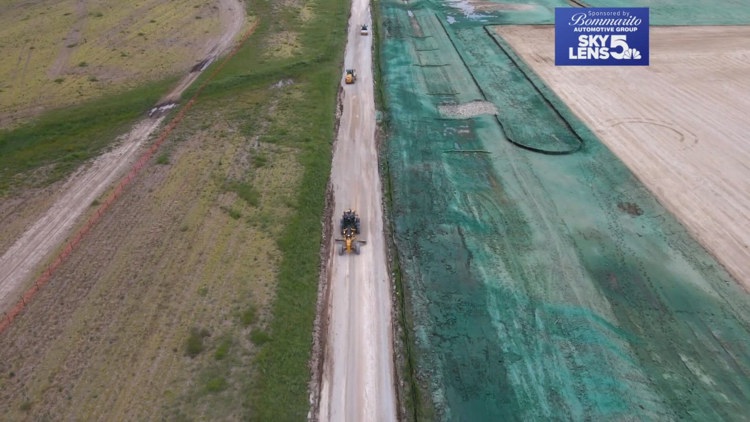
For as long as anyone in town can remember, the fairgrounds have been where farmers showed off the best of what the land gave back: the tallest corn, the best steer, soybeans enough to feed the people here and plenty of neighbors besides.
On Monday, under the same summer sky, the county celebrated a different kind of farm. Rows and rows of servers. “It’s a great day at Amazon,” the company’s vice president of public policy, Shannon Kellogg, proclaimed. He told the crowd of 150 gathered under a shade tent on the Montgomery County Fairgrounds about what bulldozers are doing on farmland just off the interchange of Interstate 70 and Highway 19, behind the Love’s gas station.
“We’re building a $10 billion state-of-the-art data center campus in this county,” Kellogg said. What’s coming is enormous. Amazon’s plans describe a campus of as many as 17 buildings on roughly 900 acres, with structures permitted to rise 200 feet. Construction has already begun.
It is the second such announcement here in recent weeks. Google confirmed last month that it is building its own campus, known in county filings as Project Spade, across the highway. Together, two of the most valuable companies on Earth are putting down roots in a county of fewer than 12,000 people.
Gov. Mike Kehoe came to mark the occasion, elevating the moment from a typical development deal into a matter of national survival. “(Artificial intelligence) dominance is the space race of our time,” Kehoe said, attributing the phrase to President Donald Trump.
The governor’s back-to-back groundbreaking announcements followed his signing of Senate Bill 4, the 2025 law that rewrote how Missouri’s largest electricity users connect to the grid and who pays for the power they draw. Asked whether either company would have come without it, Kehoe was direct. “I don’t think either of them would have landed here,” he said.
If Kehoe’s industrial power overhaul set the table, the county sweetened the menu: a steep, 25-year break on the taxes Amazon and Google would owe on the equipment inside the buildings — the servers, cooling systems and machinery. The companies will still pay real estate taxes in full.
Just how much power the two campuses will need is the question hanging over everything else, and the public answer is incomplete. Google’s campus alone, developed through a company called Kinetic Site Ventures, is targeting 1.2 gigawatts of capacity, enough to power a midsize city. Amazon has not released a comparable figure for its site, and neither company has published its projected peak demand.
That gap matters because peak demand, not average use, determines whether the regional grid can carry both campuses without straining the supply — or the rates — of everyone else connected to it.
That question is now splitting the governor’s own party. Sen. Josh Hawley has a bill in Washington that would force these companies off the public grid entirely, requiring them to generate their own power. It’s a populist position aimed squarely at the same ratepayers Kehoe said Senate Bill 4 protects. Asked whether he agrees with his fellow Republican, Kehoe gave ground. “Yes, I’ve talked to Sen. Hawley about that, and I believe the data center folks are looking at ways that they can produce their own power as well,” he said.
So the Republican governor and the Republican senator agree on the goal and differ on the path to get there: Hawley would mandate it, while Kehoe is betting the market gets there on its own. “I’m a market-based guy,” Kehoe said.
That’s a real intraparty disagreement about industrial policy, playing out in real time on the same farmland.
Senate Bill 4 passed, Kehoe noted, with an unusual alliance behind it. “Senate Bill 4 was one of the rare bills that we had that worked for economic development, and consumer protection groups got behind, because they knew that these large projects … would not be balanced on the backs of our residential consumers,” he said.
That’s the sell: economic development that consumer advocates could live with. Its durability is exactly what’s in question now.
There is another faction in this story: residents who didn’t get a vote. Montgomery County approved the projects through administrative zoning review. Data centers are permitted by right in commercial and industrial zones, the same category that permits asphalt plants, welding shops and funeral homes, with no public hearing required.
Presiding Commissioner Ryan Poston described the terms of the deal the county offered. “There’s a Chapter 100 bond for 25 years. The first 15 (years) is 95% and the last 10 (years) is at 75%. There’s no real estate property tax abatement,” Poston said. Asked to defend it, Poston scoffed at the premise. “You get hung up on the personal property tax because you don’t know what you’re looking at and understand what you’re reading there,” he said.
Amazon’s vice president pointed somewhere else entirely. Asked whether the tax break was the reason the company chose Montgomery County, Kellogg pointed instead to what Amazon was giving back: early commitments to the community, money for the fairgrounds and grants for schools. “We’re investing in emergency services here. We’re investing in these fairgrounds,” he said, noting an initial $3 million pledged for community projects.
But that figure sits against a much larger one. The personal property tax break the county is extending to Amazon could be worth as much as $900 million. The $3 million in community giving Kellogg cited amounts to a fraction of what the public is forgoing, a point I put to him directly.
Pressed on whether Amazon would have come without the tax break at all, Kellogg returned to the same frame. “It’s a very competitive place,” he said, “and you know jurisdictions are going to do what they want to do to put together that kind of incentive package and it’s an important factor.” Not the only factor, he added. But a factor.
That kind of answer has a constituency problem. Gallup found that roughly 70% of Americans oppose data centers in their communities; the number climbs to 76% in the Midwest. The opposition is bipartisan: the same crossover coalition that makes Hawley’s bill viable.
A community group has already sued the county under Missouri’s Sunshine Law, alleging officials hid water-use details and met behind closed doors. At the center of that lawsuit is a number the county was slow to provide. According to materials Amazon submitted to the county, its campus would use roughly 2.9 million gallons of water a year per building, or about 49.3 million gallons annually at full, 17-building buildout.
The water would come from wells drilled deep into the Cambrian-Ordovician aquifer, which Amazon’s consultants say holds more than 23 trillion gallons and recharges faster than it is drawn down. But the company’s own filings reveal a wrinkle its public messaging tends to smooth over. Amazon’s campus relies on direct evaporative cooling, which consumes water through evaporation, for part of the year. Google’s, by contrast, uses a closed-loop system designed to recycle water rather than lose it.
The distinction matters: Evaporated water does not return to the aquifer. The annual averages also obscure a seasonal problem. Research on data centers in hotter climates has found that water and electricity demand spike in the hottest months, precisely when nearby communities need both the most. In Arizona, one data center’s summer water use nearly doubled its average.
Neither Amazon nor Google has released a peak summer water-use figure for Montgomery County. It is part of why the AI industry increasingly builds in cold climates, where outside air does much of the cooling year-round, and part of why the question of a July heat wave — when the servers and the community draw resources at the same time — remains unanswered here.
Two public events are coming. The governor is hosting a forum this week at Missouri University of Science and Technology in Rolla. Amazon said it will hold a community open house in Montgomery County on June 23, a place to ask its experts about water, power and the environment. Both come after the deals are signed.
The governor expects the facts to do the persuading. Across both campuses, by the companies’ own estimates, the public is forgoing as much as $3 billion in taxes to bring them here. The fields are changing in Montgomery County. So is the kind of work.